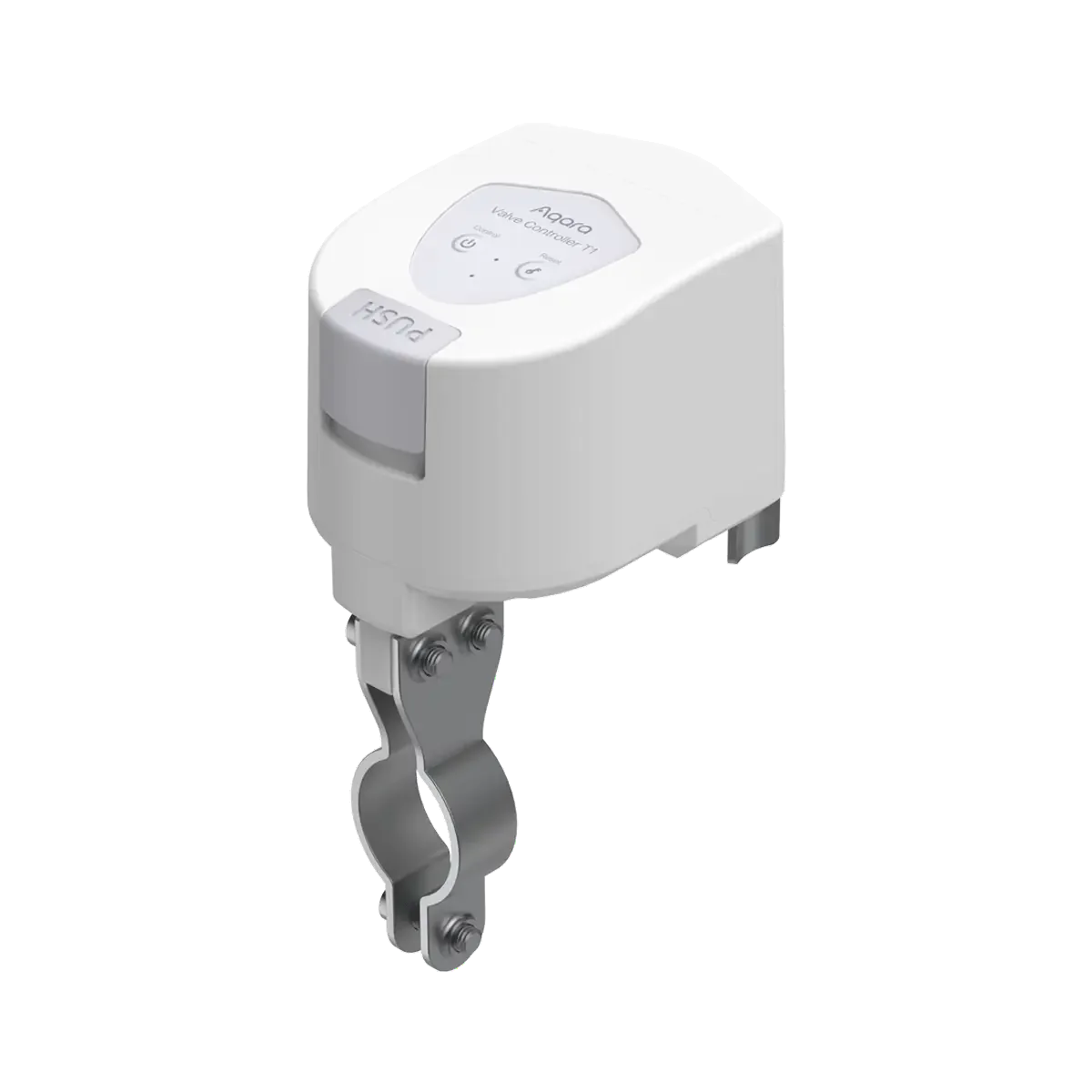
What we like
- Motorizes an existing valve without cutting into the pipe
- Four AA batteries are included, with no nearby power socket required
- Manual clutch preserves a physical way to turn the valve
- Can pair with an Aqara leak sensor for automatic shutoff
What could be better
- Needs substantial clearance around a supported lever or butterfly handle
- Hub and separate leak sensor add to the cost of automatic protection
- Indoor-only controller must remain dry
- Cannot fix a stiff valve or detect hidden leaks by measuring water flow
Remote shutoff without replacing a sound valve
Valve Controller T1 solves an unglamorous problem: the water shutoff is often somewhere inconvenient when you need it. Aqara's battery-powered motor clamps to the existing pipe and turns the existing valve handle. You can close it from an app or arrange for a leak sensor to trigger it, without replacing the valve itself.
That is an appealing upgrade for an accessible, freely moving indoor valve. It is less convincing if the pipework needs attention anyway. A motor cannot repair corrosion, free a seized handle or create room inside a cramped cupboard. If a plumber must replace the valve regardless, compare a purpose-built smart shutoff as part of that job.
Clearance matters more than the small product photo
T1 supports lever and butterfly handles on DN15, DN20 and DN25 pipes, commonly described as half-inch, three-quarter-inch and one-inch sizes. These are quarter-turn arrangements. A wheel-operated gate valve is a different mechanism, even if its pipe diameter matches.
The controller body is 93 × 72 × 84 mm, but the arm and clamp need much more room. Aqara calls for at least 187 × 248 mm above the pipe for its smaller-pipe installation, and 180 × 268 mm for DN25. Battery access and the handle's movement also need to remain practical after mounting.
A visible metal bracket in a utility room is an acceptable price for avoiding plumbing work. The same assembly behind a tightly fitted kitchen cabinet may make this the wrong product. Measure the actual valve area and confirm that the handle moves freely before ordering; pipe size alone cannot establish fit.
Batteries and a manual clutch are sensible choices
Four AA batteries are included in the current US package, so a mains socket does not have to be available beside the pipe. Aqara's up-to-two-year estimate assumes four 2900 mAh cells and one open-close cycle per day. It is a laboratory condition, not a battery-life result from our testing.
A clutch provides manual control of the arm, which is useful when the app or batteries are unavailable. It still has to be reachable. Periodically checking that the clamp stays secure and the valve completes its movement is part of owning a mechanical retrofit; a successful app command alone does not establish that water has stopped flowing.
The controller is indoor-only and has no water-ingress protection. Even though the job involves water, the motor and battery compartment need a dry position. An exposed garden valve or a place where a leaking joint would soak the unit is a poor match.
The useful purchase is more than the motor
T1 does not detect leaks or measure water flow. Automatic shutoff needs a separate sensor and an automation, typically through Aqara Home. A sensor only responds when water reaches it; this is not whole-house detection of unusual consumption or every concealed leak.
A compatible Aqara Zigbee hub is required, and Aqara specifically excludes G2H Pro for this accessory. A suitable hub can also share valve control through Matter. That makes it useful alongside the rest of a smart home, without making all apps or automation options identical.
On September 10, 2026, the controller was $69.99 at Aqara's US store and €69.99 at its EU store; the Aqara UK Shop listed £62.99 including VAT. A standalone US order comes to $79.98 with standard contiguous-US/DC delivery, before tax. The hub and leak sensor remain extra if you do not own them.
T1 makes the strongest case as an addition to an existing Aqara leak-sensor system with suitable pipework. Start from nothing and the costs accumulate; start with a stiff or inaccessible valve and the physical problem remains. Choose it for a sound valve that is worth keeping and a shutoff response you can verify in person.
Content feedback
Spot a mistake or missing context?
Send a quick note so it can be checked against the source material.