What we like
- One DIN-rail module combines switching and energy measurement
- Switches both live and neutral on one single-phase circuit
- Matter power statistics documented for SmartThings and Home Assistant
What could be better
- Needs separate circuit protection and professional panel installation
- Detailed history and exports use eWeLink
- Apple Home, Google Home and Alexa lack power statistics in SONOFF’s current matrix
A useful panel accessory for one circuit
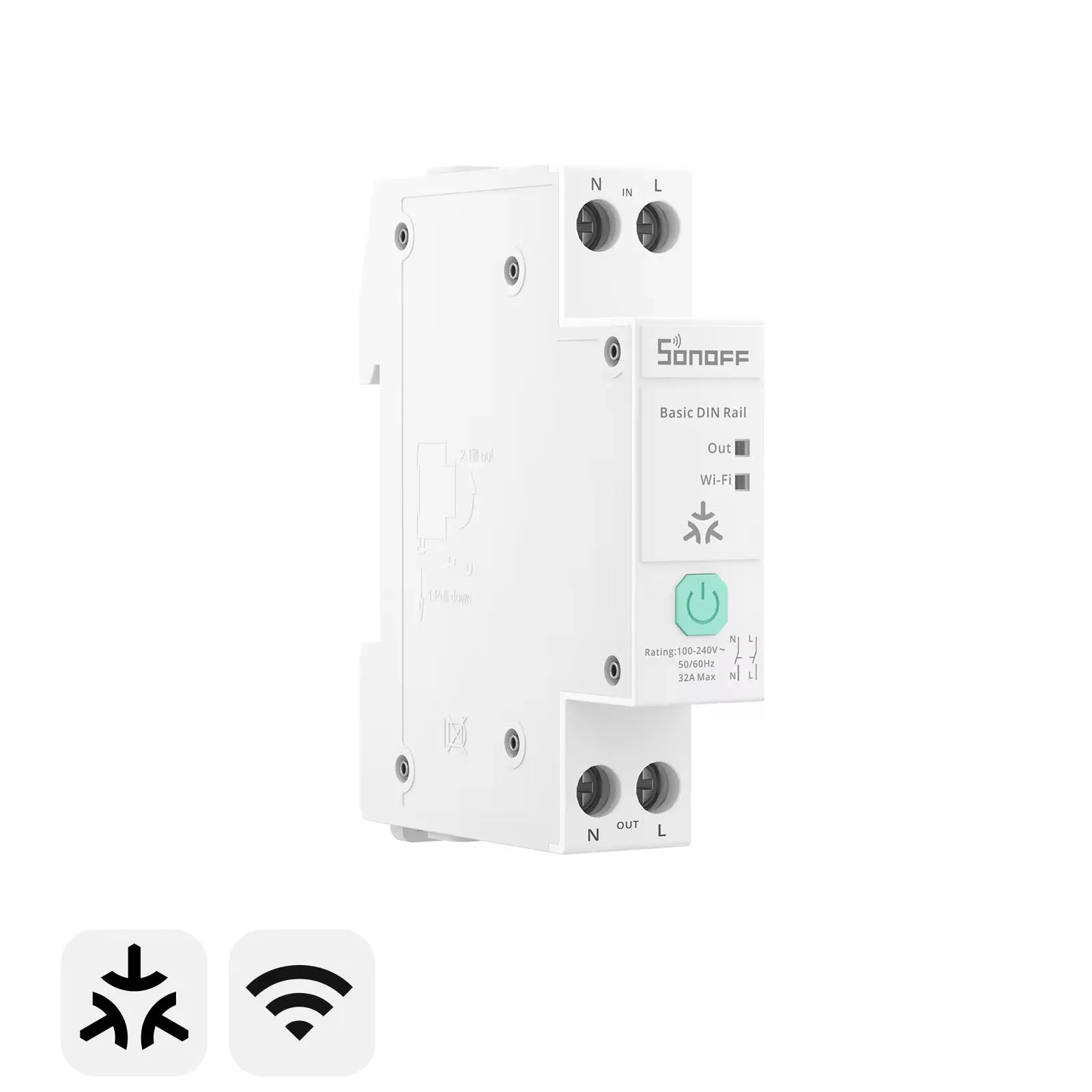
SONOFF Basic DIN Rail is interesting because it puts switching and energy monitoring into one 18 mm-wide DIN-rail module. Its listed US price was $19.90 on September 9, 2026, including tax as listed by SONOFF, with shipping and cart promotions separate. For a planned panel installation, that is a modest hardware cost for adding both control and consumption readings to one suitable circuit.
The appeal is the form factor as much as the 32 A maximum. It belongs on a DIN rail, where the electrician is already organizing the circuit hardware. You do not have to find somewhere behind a wall switch for a loose miniature relay.
It is a single-channel device. Switching both live and neutral means it disconnects two conductors for the same circuit, not that it controls two appliances independently. It also does not provide a whole-home or three-phase measurement system.
The energy record is useful, with an app tradeoff
SONOFF's eWeLink features include 180 days of energy and cost records, plus data export. That can make the module more useful than a switch you occasionally turn off from your phone: you can examine how the circuit's consumption changes over time. It still measures the circuit as a whole, without identifying each appliance connected to it.
The Matter experience depends on the platform. SONOFF currently documents power statistics in SmartThings and Home Assistant, alongside ordinary switching. Its matrix does not provide those statistics in Apple Home, Google Home or Alexa. All five are listed for on/off control.
This makes Basic DIN Rail a more attractive purchase for SmartThings or Home Assistant users who want readings alongside their controls. In the other three platforms, buy knowing that the useful consumption detail requires another app. The longer history, cost tools and exports belong to eWeLink, rather than automatically following the device into every Matter dashboard.
A smart switch still needs a circuit breaker
The narrow housing and DIN clip can make this look like a replacement for existing protective hardware. It is not. SONOFF specifies an upstream protective device; the module's configurable electronic thresholds do not replace that circuit protection.
Its 32 A maximum is for one suitable single-phase installation, and a qualified electrician must handle the panel work. The module measures 84 × 66.5 × 18 mm and needs mains power and neutral wiring. The complete installation cost will therefore be higher than the $19.90 device price.
Choose it for the DIN rail
For a wall-box retrofit up to its 16 A resistive-load limit, the equally priced MINI ONE PM is smaller and offers local browser control. It is a different installation choice, not a DIN-rail drop-in replacement. For simple inline switching without energy data, Basic Gen5 costs just $5.99, with a lower 10 A resistive-load limit.
Choose Basic DIN Rail when the panel location, single-circuit metering and higher capacity are the actual requirements. Its value weakens if you only need to automate one lamp or expect a complete energy dashboard inside Apple Home.
Content feedback
Spot a mistake or missing context?
Send a quick note so it can be checked against the source material.