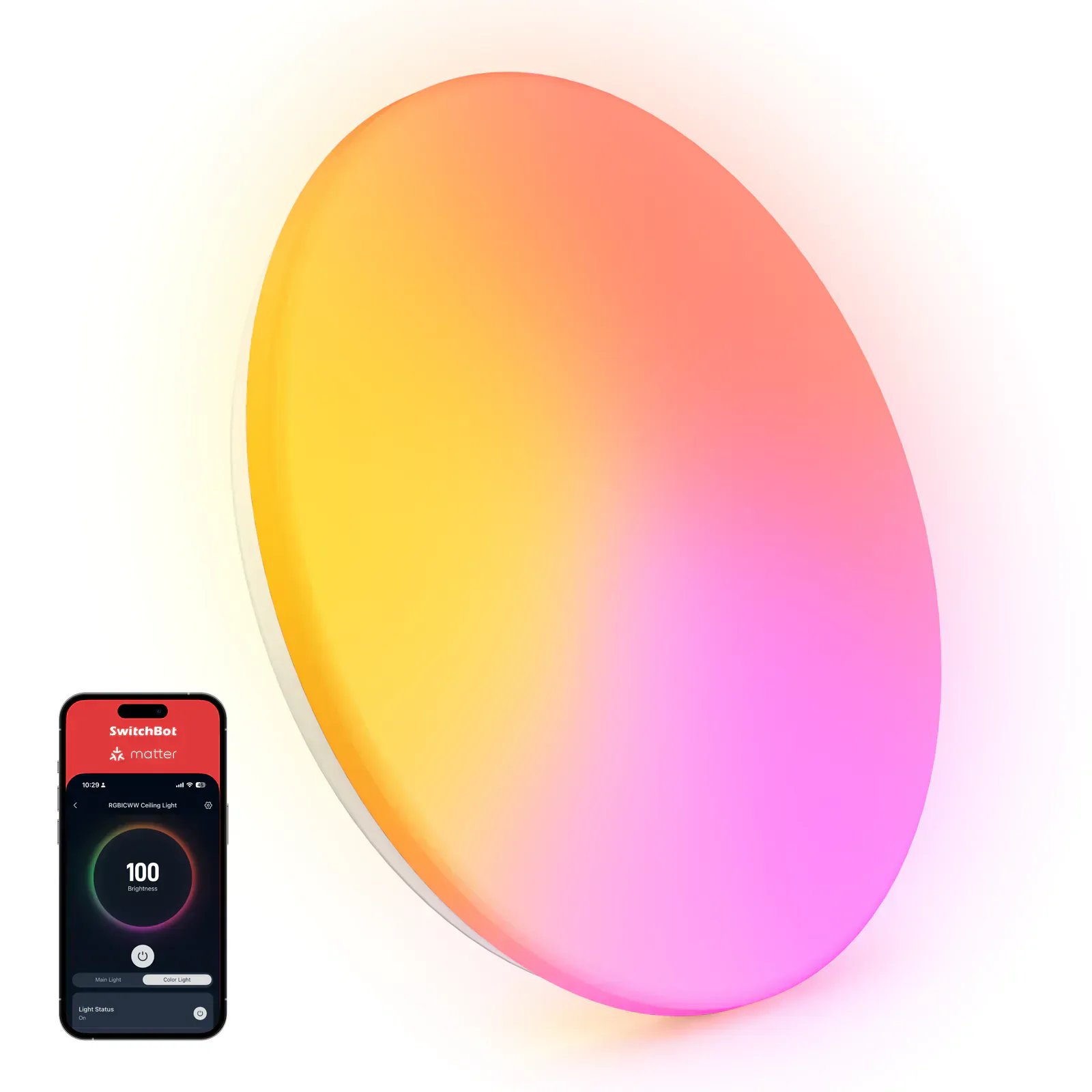
SwitchBot's RGBICWW Ceiling Light is now being covered as a Matter smart-home option, after T3 reported on June 29, 2026, that the new fixture combines Matter support, smooth dimming, and a lower price than many whole-room smart lighting upgrades. The important detail is the form factor: this is not a bulb or a plug-in lamp. It is a hardwired ceiling fixture that has to make sense before the Matter logo matters.
SwitchBot lists 12 inch and 15 inch versions, with product pages showing the ceiling-light line alongside Matter compatibility. T3 reported the smaller model at $49.99 and the larger model at $69.99, with up to 2,000 lumens for the 12 inch fixture and up to 3,200 lumens for the 15 inch fixture. Matterhome has separate compatibility guides for both sizes because the buying decision changes with the room, not only with the protocol.
A ceiling light is harder to undo
The appeal is clear enough. A direct Matter-over-Wi-Fi ceiling light can join Apple Home, Google Home, Alexa, SmartThings, or Home Assistant without making the buyer add a SwitchBot hub or Thread border router first. That is a simpler network path than a Thread light in a home with no Thread hardware, and it is cleaner than putting a smart bulb inside a fixture that someone might still turn off at the wall.
The tradeoff is installation. A hardwired fixture is not the same risk as a strip light or a floor lamp. Before buying, confirm the ceiling box, wiring, room size, local electrical requirements, and whether the fixture can be installed safely. If that answer is unclear, this is a better job for an electrician than for a Matter experiment.
Matter should handle the daily controls
For normal use, expect Matter to be most useful for power, brightness, color, white temperature, scenes, voice control, and automations in the main home app. That is enough for a bedroom, office, hallway, or small living area where the light needs to behave like part of the room rather than like a decorative accessory.
Do not assume Matter will replace the SwitchBot app for every RGBICWW behavior. Advanced effects, firmware updates, and product-specific settings usually remain brand-app territory even when the core light endpoint appears cleanly in Matter. Home Assistant users should also start with one fixture and verify color-light behavior in their own Matter stack before installing several.
Choose the size by the room
The 12 inch model is the lower-risk pick for smaller rooms, hallways, and compact spaces where a flush fixture looks better than a lamp. The 15 inch model is the one to consider when the room needs broader ceiling coverage and the fixture will be the primary light rather than an accent.
The skip case is straightforward. If a replaceable smart bulb, a plug-in lamp, or a light strip would solve the same problem with less installation friction, start there. The SwitchBot ceiling light is most interesting when you specifically want a fixed ceiling fixture that joins Matter directly and you are willing to finish the wiring and setup before judging the ecosystem behavior.
Content feedback
Spot a mistake or missing context?
Send a quick note so it can be checked against the source material.