What we like
- Combines a usable shelf, forward task light and rear ambient color
- Walnut veneer gives the desk a warmer furniture finish
- Touch buttons keep ordinary lighting controls within reach
- Included center support raises the stated load capacity to 70 kg
What could be better
- Fixed 12.1 cm lift and one-meter width will not suit every desk
- Required 15 W or stronger USB-C PD/QC adapter is not included
- Touch brightness control changes behavior when the task light is on
- Much more expensive than a plain riser if the lighting is unnecessary
A handsome shelf when all three jobs are useful
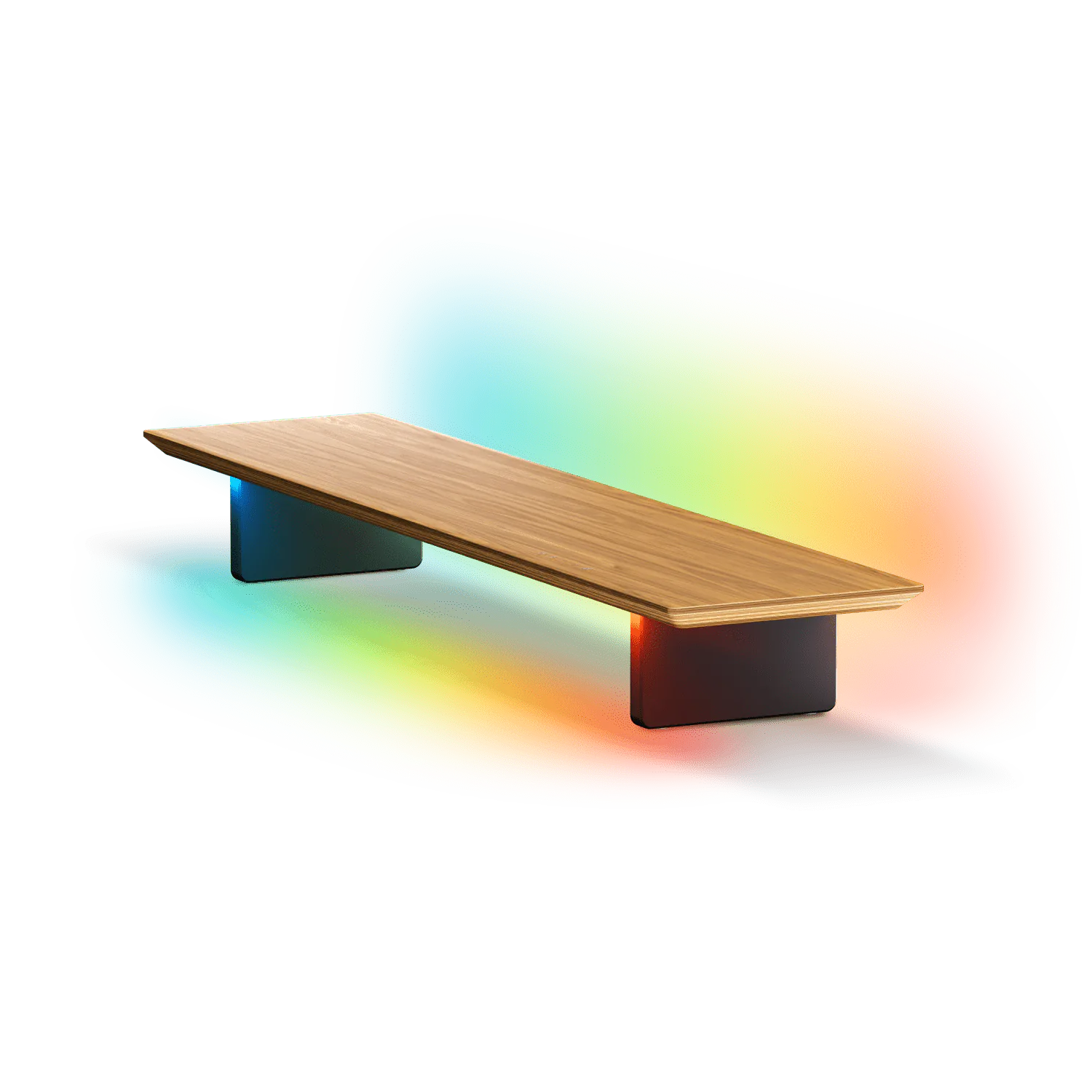
The Nanoleaf x FANTAQI Smart LED Monitor Stand makes sense as a combined purchase: a monitor riser, a forward task light and a colored glow behind the screen. The walnut veneer is a more convincing reason to choose it than another row of smart-home logos. It can make a desk feel like furniture while keeping the lighting built in.
The catch is that you have to want the shelf itself. If an existing monitor arm already puts the screen where it belongs, adding a one-meter stand mainly to get RGB lighting spends money and desk space without solving the monitor problem.
Fixed height matters more than the generous weight rating
The stand measures 100 × 22.5 × 12.1 cm, or about 39.4 × 8.9 × 4.8 inches. That is a fixed lift under the monitor's own base. Raising a screen that is already high enough can make the arrangement worse, and the stand does not offer an arm's height or position adjustment.
Its shelf can organize accessories and leave space underneath for smaller items. It also occupies a broad strip of the desk. A monitor with widely spread feet needs both its footprint and weight checked; a headline screen-size claim does not establish that every base fits the top.
Nanoleaf rates it for 28 kg without the center support and 70 kg with that support installed. The column is included, but it divides the opening beneath the shelf. Decide whether the heavier load or an uninterrupted storage space matters more. These are manufacturer limits, not loads we have physically tested.
The top is plywood with natural walnut veneer, rather than a solid slab of walnut. That is a sensible construction for a shelf, but the distinction matters when judging the furniture premium. The finish and integrated lighting need to justify the price together.
The task light gives it a reason to stay on during work
Nanoleaf rates the dedicated white task channel at 550 lumens, with CRI 97 and a 1700–6500 K range. The useful idea is lighting the desk while the rear adds color separately. With task lighting off, the front can join the RGB effects as well.
The rear lighting has 102 advertised addressable zones for gradients and scenes. A nearby wall gives that light something to reflect from; a desk facing open space will get a different effect. We have not measured glare, color rendering or illumination across a keyboard, so the specifications do not establish that it replaces every adjustable desk lamp.
Five touch buttons provide everyday control, although they have an awkward detail: the brightness buttons adjust the task light while it is on. Adjusting RGB brightness with those buttons first requires switching the task light off. Nanoleaf's app is the more flexible route when both channels need individual attention. The manual also says Screen Mirror cannot be scheduled.
Plan for a separate power adapter
The box includes a USB-C power cable, legs, center support and assembly tool, but no power adapter. Nanoleaf requires a compatible PD or QC USB-C adapter supplying at least 15 W. Budget for one if a suitable spare is unavailable, rather than assuming any old phone plug is enough.
The manual also advises against sharing the same charger with another high-power USB-C device. That matters on a desk where every charger already has a job. The USB-C connection powers the stand; it should not be mistaken for an included laptop dock or charger.
Matter over 2.4 GHz Wi-Fi provides ordinary ecosystem lighting control through a compatible controller. Screen Mirror, music response and coordinated Nanoleaf effects are the reasons to keep using Nanoleaf's own apps. Do not base the purchase on every platform exposing both lighting channels in exactly the same way.
Worth it when the shelf and lighting both earn their place
On September 10, 2026, the US offer was $169.99 in stock. Standard contiguous-US delivery makes $179.98 before tax and any charger. That price is defensible when the shelf, task lighting and RGB background all replace purchases you actually intended to make.
For a single monitor that only needs elevation, IKEA ELLOVEN was $29.99 before delivery and tax. Its 18.5-inch-wide top, four-inch height and 44-pound load limit make it a smaller, different riser, with a drawer and no lighting. It is the more economical starting point if those dimensions fit.
Keep an existing stand and lamp if they already work well. Choose Nanoleaf when the walnut shelf and both kinds of lighting improve a desk you have measured, rather than buying it first and rearranging a comfortable workspace to justify it.
Content feedback
Spot a mistake or missing context?
Send a quick note so it can be checked against the source material.