What we like
- Uncluttered wall control with separate brightness adjustment
- Preferred switch-on brightness and configurable status light
- Device-stored schedules without an Eve account or subscription
What could be better
- $54.95 is a substantial premium over a basic Tapo dimmer
- Requires neutral wiring and suitable ordinary dimmable lighting
- Eve’s conflicting three-way guidance needs confirmation before purchase
The wall control is the attraction
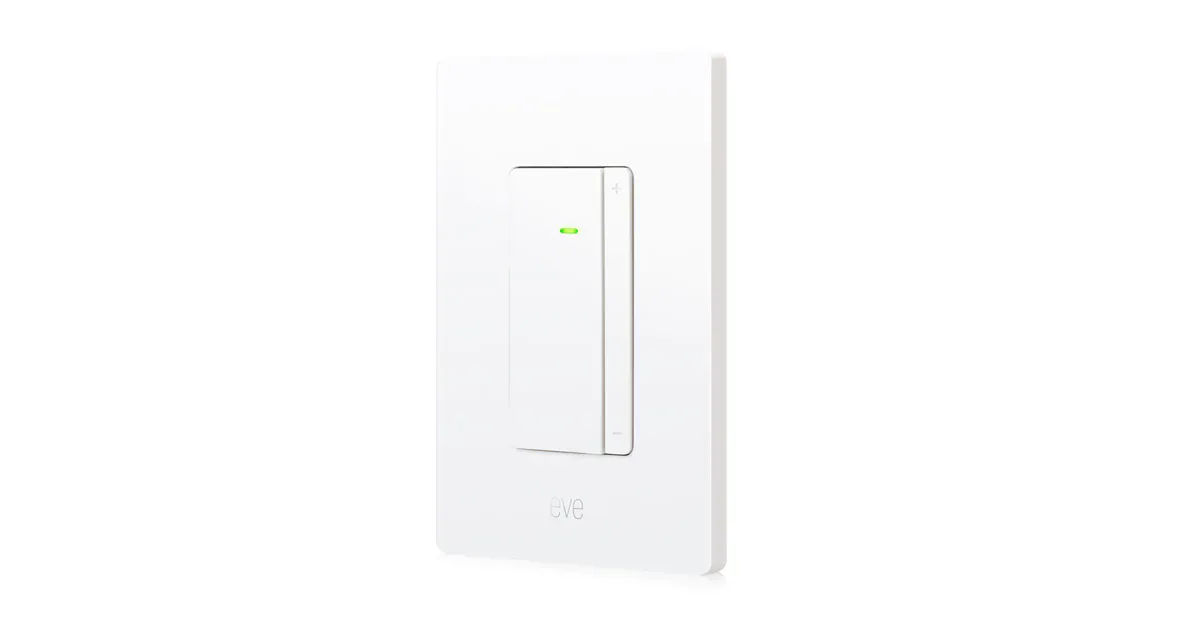
Eve Dimmer Switch looks restrained: a broad on/off touch button, a small status light and a slim plus/minus rocker down the right side. There is no row of bright level indicators across the face. It suits a room where the switch should blend into the wall, though someone who likes the visible position of a traditional slider may prefer a different design.
The controls have useful refinements. A long press on plus takes the light to full brightness. You can choose whether switching on restores the previous level or uses a preferred brightness, and make the status LED act as a night-time guide or stay off. Those are small decisions that affect every use, especially in a bedroom.
Eve includes a wall plate, and the standard format can fit an appropriate existing single or multi-switch plate. The light fixture keeps its ordinary dimmable bulbs. That is attractive for a chandelier or a group of downlights you already like, provided you want them to brighten and dim together.
A premium that needs a purpose
The checked Eve US offer is $54.95 for one dimmer before shipping and installation. A single Tapo S505D is $18.99 before shipping. For a straightforward single-pole LED circuit, Eve costs almost three times as much in hardware. We would choose Tapo when inexpensive wall dimming is the priority.
Eve earns consideration if you already use Thread and want its app controls without another manufacturer account. Schedules run on the switch once configured, independently of the phone, hub or internet connection. The Eve app provides them through Apple Home on iPhone/iPad or Google Home on Android. Other Matter platforms still provide ordinary light control and their own automations, but not that Eve interface.
Eve also records when, how long and at what brightness the light was on. That is a usage history, not a measurement of the fixture's electricity consumption. It should not be the reason to pay extra for an energy-monitoring project.
The fixture still decides the result
This is a 120 V dimmer requiring neutral wiring, a suitable indoor installation and a compatible Matter controller with Thread border router. The minimum load is 3 W; ratings include 150 W LED, 600 W incandescent/halogen and 300 VA magnetic low-voltage lighting. It is unsuitable for ceiling-fan speed control or dimming smart bulbs.
Eve's app can tune the bulb type and dimming range, but that does not establish how quietly or deeply your particular fixture will dim. Have the installer confirm the load match before replacing a satisfactory existing dimmer.
Three-way use needs a further check. Eve's product page says single-pole, while its linked installation guide describes one Eve dimmer at the load-side location with a conventional switch at the other end. Confirm the exact unit and arrangement with Eve and the installer before buying for two wall locations. It is not a pair of smart dimmers that can be wired interchangeably.
Content feedback
Spot a mistake or missing context?
Send a quick note so it can be checked against the source material.